

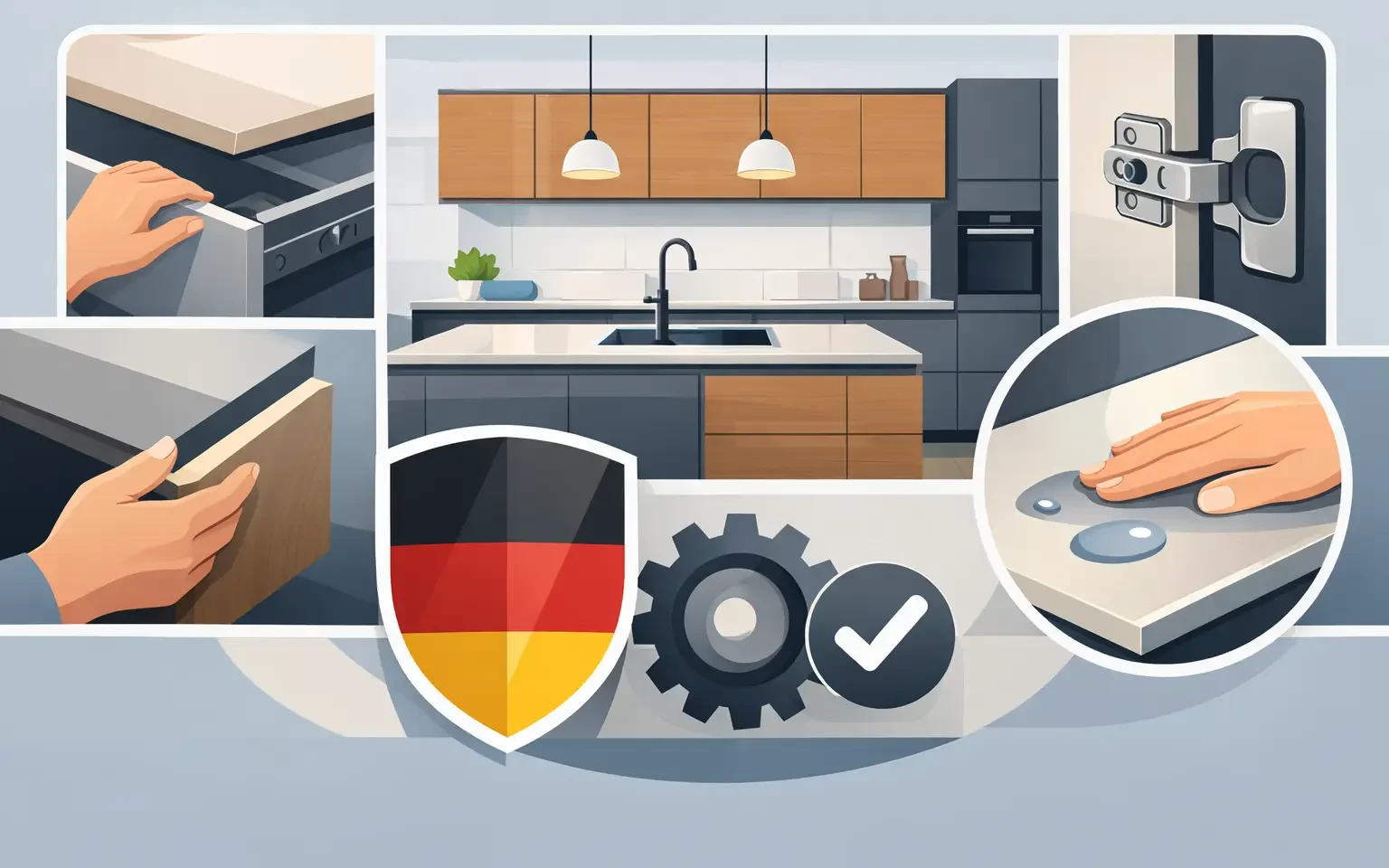
What Makes German Kitchens Durable? 7 Details
A kitchen is judged over years, not on installation day. Cabinet doors are opened thousands of times, drawers carry heavy cookware, and the area around the sink must withstand moisture, steam, and daily cleaning. What makes German kitchens durable is not one visible feature, but a disciplined manufacturing approach in which materials, construction, hardware, and installation are designed to work together.
For homeowners planning an upscale remodel, that distinction matters. A beautiful kitchen can lose its appeal quickly when doors sag, edges swell, or drawer runners begin to bind. German-made cabinetry is engineered to keep its visual precision and practical performance through the demands of daily life.
What Makes German Kitchens Durable?
German kitchen durability begins with repeatable factory production. Rather than relying on broad tolerances or extensive on-site modification, leading German manufacturers use highly controlled processes to cut, drill, edge, and assemble components with consistency. Cabinet boxes, doors, and fittings are made to exact specifications, so the finished kitchen aligns properly and continues to operate as intended.
This precision is especially valuable in contemporary kitchens. Flat-front cabinetry, narrow reveals, integrated appliances, and continuous handleless lines leave little room to hide uneven gaps or poorly fitted parts. Accurate production supports the clean, architectural appearance that defines modern European design while also reducing stress on moving components.
Durability, however, is not simply about making cabinets heavier. It is about selecting the right material and construction method for each part of the kitchen, then manufacturing it with care.
Engineered Cabinet Panels Built for Daily Use
Many premium German kitchens use high-quality engineered wood panels for cabinet carcasses, fronts, and interior components. This can surprise homeowners who associate durability only with solid wood. In cabinetry, well-made engineered panels offer meaningful advantages: they are dimensionally stable, consistent in thickness, and less likely to move significantly with normal changes in indoor temperature and humidity.
The quality of the panel matters. Dense, carefully manufactured board provides a dependable foundation for hinges, drawer runners, shelf supports, and connectors. It also creates a stable surface for durable decorative finishes, whether the desired look is matte lacquer, textured wood effect, veneer, or high-pressure laminate.
Solid wood still has a place in luxury interiors, particularly for select door styles and furniture-like details. But it naturally expands and contracts with moisture changes. In Houston and other warm, humid climates, a thoughtfully engineered cabinet system can be the more practical choice for maintaining consistent alignment over time.
Protected Edges and Moisture Management
Kitchen damage often begins at the edges. Water from a sink, dishwasher steam, frequent mopping, or an overlooked spill can penetrate an exposed or poorly sealed cabinet edge. Once moisture reaches the panel core, swelling and surface separation can follow.
German kitchen manufacturers place considerable attention on edge treatment. Precisely applied edging protects vulnerable panel sides and gives doors and cabinet boxes a finished, refined appearance. The bond must be consistent, particularly around sink cabinets, dishwashers, and high-use drawer fronts.
No cabinet system should be treated as waterproof. A major leak, standing water, or neglected plumbing problem can damage almost any kitchen. The advantage of a well-engineered German kitchen is that it is designed to manage ordinary kitchen moisture more effectively, with protected surfaces, accurate panel joins, and components selected for demanding conditions.
Hardware That Is Tested, Adjustable, and Serviceable
A cabinet door may look simple, but its long-term performance depends heavily on the hinge. The same is true of drawers, pull-outs, lift-up doors, and pantry systems. Premium German kitchens use sophisticated hardware designed for high cycle counts, controlled motion, and precise adjustment.
Soft-close hinges and drawer runners are not merely luxury conveniences. They reduce impact during use, help preserve alignment, and make a kitchen feel composed every time it is opened or closed. Full-extension drawers also allow homeowners to access the entire drawer box rather than repeatedly pulling and straining the contents at the front.
Adjustability is equally important. A home settles, seasonal conditions change, and a kitchen is used hard. Quality hardware allows a trained installer to fine-tune reveals and door positions without replacing the cabinet. This serviceability helps protect the original investment well beyond the first year of ownership.
Construction That Supports Clean Lines and Heavy Storage
Modern European cabinetry often uses a frameless construction style, sometimes called full-access construction. Cabinet doors and drawers attach directly to the cabinet box rather than sitting within a face frame. The result is a more streamlined appearance and greater usable storage inside the cabinet.
When engineered correctly, this construction is exceptionally strong. Cabinet boxes rely on accurately machined panels, secure connectors, stable backs, and proper support at wall-mounted units. Deep drawers can be specified for pots, dishes, pantry goods, and small appliances, while tall cabinets can integrate refrigeration, ovens, and storage in a unified composition.
The trade-off is that precision becomes non-negotiable. Frameless cabinetry does not disguise a wall that is out of plumb or a floor that is uneven. This is why professional field measurement, thoughtful design, and experienced installation are central to the durability of the finished kitchen.
Finishes That Balance Beauty With Real-Life Care
A high-end finish should complement the way a household lives. German kitchen collections offer a wide range of surfaces, from tactile wood reproductions and anti-fingerprint mattes to lacquered fronts and natural veneers. Each has a different maintenance profile, and the most durable choice depends on the household.
Matte laminate and premium melamine surfaces are popular for active family kitchens because they offer strong resistance to everyday marks and are straightforward to clean. Lacquered fronts can deliver a richer, more tailored color expression, but they deserve more attentive care to avoid scratches from abrasive products. Veneer brings genuine wood character and variation, though it should be selected with an appreciation for natural material behavior rather than an expectation of a perfectly uniform surface.
The right choice is not always the most expensive finish. It is the finish that suits the home’s light, cooking habits, cleaning routine, and design priorities. A knowledgeable kitchen designer can help clients weigh these considerations before finalizing a door style.
Interior Details Matter More Than They First Appear
Durability also lives inside the cabinets. Adjustable shelves need sufficient thickness and proper support. Drawer boxes should feel stable under load. Pull-out systems need hardware that remains smooth when fully stocked. Interior surfaces should tolerate the friction of dishes, cookware, and pantry containers without looking worn after a short period.
Thoughtful organization reduces unnecessary strain on a kitchen. A drawer designed for cookware, for example, keeps weight low and supported rather than forcing homeowners to overload an upper cabinet. Integrated recycling, pantry pull-outs, and internal dividers can also prevent clutter from turning high-use storage into a daily source of wear.
These details are part of the German design tradition: function is considered early, not added as an afterthought.
Why Installation Is Part of Kitchen Durability
Even exceptional cabinetry can underperform when installation is rushed. Walls must be assessed, floors checked, appliances coordinated, and cabinets leveled and secured correctly. A tall pantry that is not properly anchored, a wall cabinet mounted without adequate support, or a dishwasher installed without appropriate protection can compromise both appearance and performance.
Professional installation also ensures that doors, drawers, fillers, panels, and appliance fronts are adjusted as a complete system. This is particularly relevant for integrated appliances and handleless kitchens, where small inconsistencies become immediately visible.
At Häcker European Collection, the design and installation process is approached as one connected service. That coordination helps ensure the cabinetry specified in the showroom is properly measured, detailed, delivered, and installed in the home.
A Durable Kitchen Starts With Better Decisions
The most enduring kitchen is not necessarily the one with the most features. It is the one designed around the household, built from well-specified materials, and installed with the precision its construction requires. Before choosing cabinetry, ask to see how the doors feel, how the drawers perform under weight, how edges are finished, and how the installation team manages real-site conditions.
A design consultation is the right place to compare finishes, storage systems, and construction details against the way you actually cook and live. That is how a German-made kitchen becomes more than a striking first impression – it becomes a dependable part of the home for years to come.

