

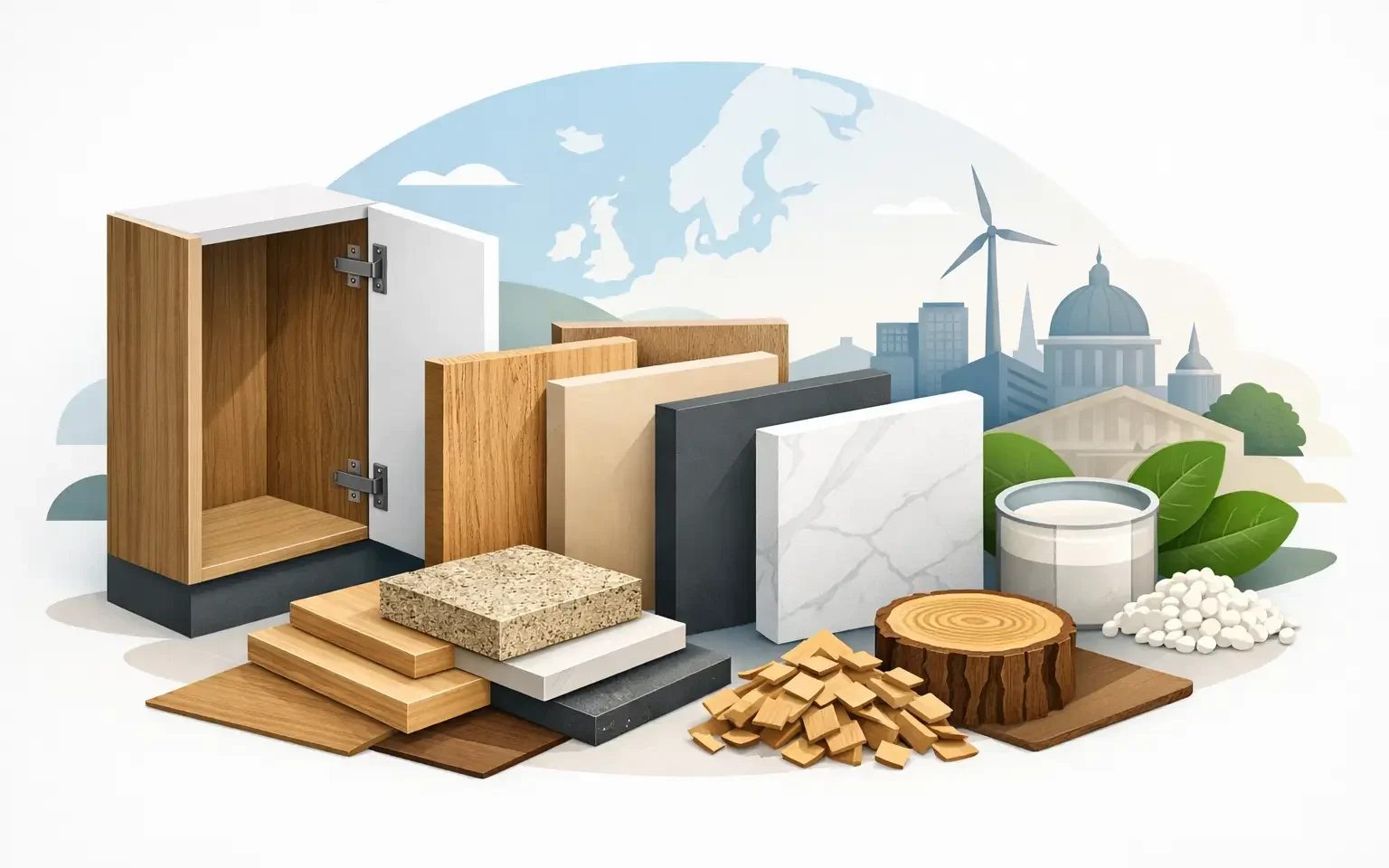
What Are European Cabinets Made Of? Materials
A modern European kitchen earns its refined appearance long before the doors are installed. The materials beneath the finish determine how cabinets handle humidity, daily use, alignment, and years of opening and closing. So, what are European cabinets made of? Most are built from highly engineered wood-based panels, precision hardware, durable surface finishes, and carefully matched components rather than thick solid-wood framing.
That distinction matters for a Houston kitchen remodel. Heat, humidity, busy households, and high expectations place real demands on cabinetry. Quality European systems are designed as complete products, with the cabinet box, fronts, edges, hinges, drawers, and installation details all working together.
What Are European Cabinets Made Of at Their Core?
European cabinets are usually made with engineered panels for the cabinet carcass, or box. These panels offer consistency, structural stability, and a clean surface that suits the frameless construction common in German-made kitchens.
The primary materials are typically particleboard, medium-density fiberboard (MDF), and high-density fiberboard (HDF). These are not interchangeable materials, and the right choice depends on the component, finish, and intended use.
Engineered particleboard for cabinet boxes
High-quality particleboard is widely used for cabinet sides, bottoms, tops, shelves, and interior partitions. It is produced by compressing refined wood particles with resin under controlled conditions, creating a dense, uniform panel. When properly specified and finished, it provides an exceptionally stable foundation for cabinetry.
For many homeowners, the word particleboard raises concerns because it is associated with inexpensive furniture. That comparison misses the difference in panel quality, density, moisture resistance, edge treatment, and construction standards. Premium European cabinet manufacturers use furniture-grade panels engineered for precise machining and dependable performance. A well-made cabinet box is not judged by the material name alone, but by the quality of the panel and the system built around it.
This material also supports the streamlined geometry that defines modern cabinetry. Its consistent composition allows for accurately drilled hardware locations, crisp panel joints, and reliable adjustment during installation.
MDF and HDF for smooth, detailed surfaces
MDF is made from finely processed wood fibers compressed into a smooth, dense board. It is particularly well suited for painted, lacquered, and thermofoil cabinet fronts because it creates an even surface with no grain pattern telegraphing through the finish.
MDF can also be shaped for select door profiles, although European kitchens often favor flat-panel slab fronts and restrained contemporary details. HDF is denser and is often used where a thinner yet strong panel is required, such as cabinet back panels or specialty applications.
Neither MDF nor HDF is automatically better than particleboard. They serve different roles. A knowledgeable kitchen designer selects each material based on performance requirements, visual goals, and the construction method of the cabinet line.
Surface Finishes Define the Visible Experience
The surface is what you touch every morning, see under changing light, and clean after dinner. European cabinetry offers an extensive selection of finishes, from soft matte solids to natural wood textures and high-gloss lacquer. The finish is applied to, bonded to, or integrated with the engineered core panel.
Melamine and laminate finishes
Many premium European cabinet interiors and exterior fronts use melamine or laminate surfaces. These finishes are valued for their color consistency, scratch resistance, easy maintenance, and broad range of realistic wood, stone, metal, and solid-color looks.
Melamine is a resin-infused decorative paper fused to a panel surface. Modern versions can have remarkably convincing texture, including synchronized grain patterns that align visual and tactile wood details. Laminate generally refers to layered decorative materials bonded to a substrate. Both can deliver a tailored, high-end result when sourced and fabricated to exacting standards.
For active family kitchens, quality matte laminate or melamine can be an excellent choice. It provides a refined modern look with practical resistance to fingerprints and routine wear. Performance varies by manufacturer, however, so homeowners should compare samples in person rather than selecting a finish solely from a screen.
Lacquered fronts
Lacquered cabinet doors create a more polished, furniture-like surface. Depending on the collection, the lacquer may be matte, satin, or gloss, offering considerable freedom in color and light reflection. A matte lacquer can make a large kitchen feel calm and architectural, while a glossy finish can add brightness and visual depth.
Lacquer is often associated with luxury because of its smooth appearance and careful finishing process. It does require thoughtful care. It can be more vulnerable to visible scratches than a highly textured laminate, particularly in high-contact areas. For clients who prioritize a precisely matched color and an elevated painted finish, that trade-off may be worthwhile.
Wood veneer and wood-effect fronts
Natural wood veneer remains a defining material in many high-end European kitchens. Veneer is a thin layer of real wood applied to an engineered core, allowing the finished door to show authentic grain, variation, and warmth while remaining more stable than a solid wood slab.
A veneer front is not an imitation. It is real wood, selected and finished to bring natural character into a contemporary composition. Because every veneer has variation, it is ideal for homeowners who appreciate an organic material rather than a perfectly uniform repeat.
Wood-effect laminates offer a different advantage: a consistent, durable interpretation of wood that can be easier to maintain and specify across a larger kitchen. The decision is aesthetic as much as practical. Veneer brings authenticity and individuality; premium wood-effect surfaces deliver consistency and resilience.
Edges and Construction Are Part of the Material Story
A cabinet panel is only as dependable as its exposed edges and connections. European manufacturers commonly use laser, PUR, or other advanced edge-banding methods to seal panel edges and create a clean visual transition between the face and the edge. This helps protect the core from moisture and contributes to the nearly jointless look associated with premium cabinetry.
Frameless construction is another hallmark. Unlike traditional face-frame cabinetry, European cabinets rely on a precisely engineered box without a separate front frame. Doors mount directly to the cabinet sides, producing narrow reveals, more usable interior space, and a tailored linear appearance.
This construction requires accuracy. When cabinet boxes, drawer runners, and hinges are manufactured to tight tolerances, the finished kitchen can maintain consistent gaps and smooth operation across a full wall of cabinetry.
Hardware Is Not an Afterthought
The hardware inside a cabinet has a direct effect on how the kitchen feels every day. Quality European cabinetry typically uses concealed hinges, full-extension drawer systems, soft-close mechanisms, and adjustable mounting plates. These components are often made from steel, aluminum, and durable engineered polymers designed for repeated use.
A shallow drawer with a poorly designed runner can undermine even the most beautiful door finish. In contrast, well-engineered drawer systems keep cookware, pantry items, and internal organizers accessible while preserving the clean exterior of the kitchen.
The same principle applies to lift-up doors, pocket doors, pull-out pantries, recycling centers, interior lighting, and integrated organization. These features add cost, but they also turn cabinetry into a more functional storage system. During design, it is wise to invest in hardware for the areas used most often, such as cooking zones, waste storage, and primary drawers.
Are European Cabinets Made of Solid Wood?
Some European cabinets incorporate solid wood, especially for specialty details, select door styles, drawer accessories, or interior elements. Yet solid wood is not usually the main material for contemporary cabinet boxes. That is intentional, not a compromise.
Solid wood expands and contracts with seasonal changes in humidity. Engineered panels are more dimensionally stable, which is valuable for wide doors, flush surfaces, and precise reveals. In a modern kitchen, stability is often more important than the traditional expectation that every cabinet component should be solid wood.
The stronger question is not whether a cabinet contains solid wood. It is whether each material has been chosen for the job it needs to perform. A premium cabinet should feel substantial, operate precisely, resist ordinary household demands, and retain its visual integrity over time.
Material Quality Should Include Health and Sustainability
For a home renovation, material selection is also about indoor living. Reputable European manufacturers commonly work within strict emissions and quality standards for wood-based panels, adhesives, and finishes. Ask about low-emission certifications, the origin of the materials, and the manufacturer’s approach to responsible forestry and production.
Sustainability is not limited to a single label. A cabinet that remains functional, repairable, and visually relevant for many years can reduce the need for premature replacement. Durable surfaces, replaceable hardware, and thoughtful installation all contribute to that longer service life.
At Häcker European Collection, the design process begins with how you live, then matches material, finish, storage, and layout to that reality. The best cabinet material is rarely the one with the most familiar name. It is the one that gives your kitchen the right balance of modern design, long-term performance, and confidence every time you use it.

