

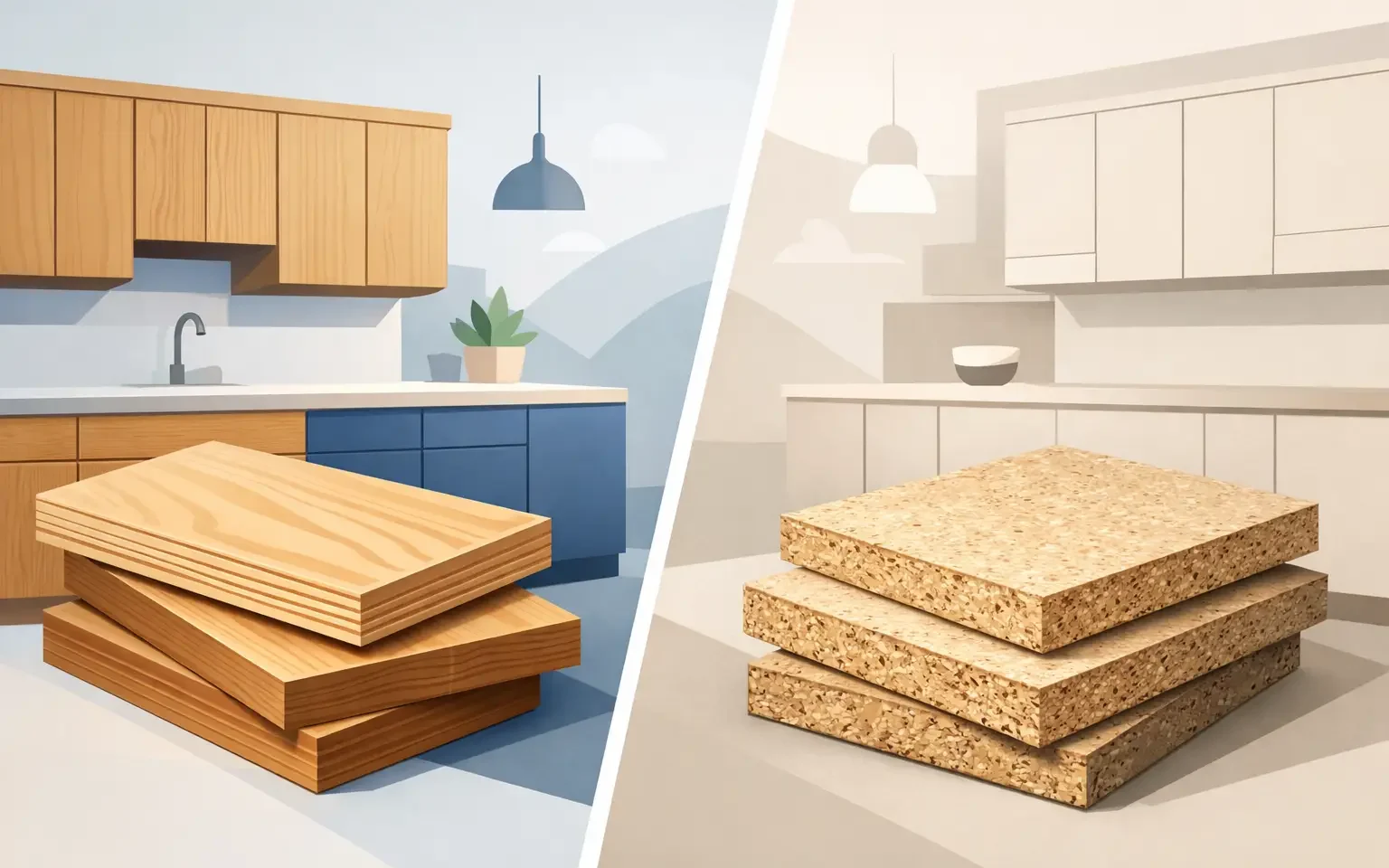
Plywood Versus Particleboard for Cabinetry
A cabinet box is rarely the first thing a homeowner notices in a showroom. The door style, finish, lighting, and interior organization usually take center stage. Yet plywood versus particleboard is one of the material decisions that can influence how cabinetry performs through years of daily use, especially in a kitchen where humidity, heat, and heavy storage are part of everyday life.
The right choice is not as simple as declaring one material universally superior. Cabinet construction depends on the grade of the board, the engineering behind the cabinet, the quality of the edge treatment, the hardware, and the precision of installation. For a high-end kitchen, the goal is to select materials that support the intended design, expected use, and long-term value of the home.
Plywood Versus Particleboard: The Core Difference
Plywood is made from thin layers of wood veneer bonded together with alternating grain directions. This cross-laminated construction gives the panel strength and helps it resist warping. Quality plywood is widely valued for structural applications, particularly when a cabinet must carry substantial weight or withstand challenging moisture conditions.
Particleboard, often called furniture board or engineered wood board in cabinetry, is made from wood particles and resin pressed into a dense panel. It is not the same material as MDF, which uses much finer wood fibers and has different finishing characteristics. In modern European cabinet manufacturing, high-quality particleboard is frequently used as a core material for cabinet boxes because it is stable, consistent, and well suited to precision-machined components.
Material names alone do not reveal quality. A low-density particleboard panel with poor edge sealing is very different from a dense, low-emission board manufactured for premium cabinetry. Likewise, thin, low-grade plywood should not be compared to furniture-grade plywood with a durable veneer core and proper finishing.
Where Plywood Has an Advantage
Plywood has a strong reputation for good reason. Its layered construction offers excellent screw-holding ability, an important consideration at hinge locations, drawer-slide mounting points, and heavily loaded shelves. It also tends to perform better than standard particleboard if it is exposed to moisture for an extended period.
For homes where a kitchen may face unusual humidity, a utility area sees frequent wet use, or cabinetry will support especially heavy loads, plywood can be a highly practical choice. It is also a familiar preference for homeowners who want visible wood construction inside a cabinet or who are planning a more traditional custom-built aesthetic.
However, plywood is not automatically impervious to water. Water can still penetrate unfinished edges, weaken adhesive bonds, or cause delamination over time. The exterior finish, edge protection, and installation details around plumbing and appliances remain essential. A dishwasher leak can damage almost any cabinet material if it goes unnoticed long enough.
Plywood may also have natural variations in its core. Depending on the grade, voids or inconsistencies within the panel can affect machining and the appearance of exposed edges. In a refined modern kitchen, those details matter, particularly when clean lines and tight reveals are central to the design.
Why Premium Particleboard Is Common in European Cabinetry
European cabinetry is engineered as a complete system rather than a collection of individually built boxes. Dense particleboard panels offer a smooth, uniform surface for decorative laminates, melamine finishes, veneers, and precision-applied edge banding. That consistency supports the crisp alignment and sophisticated finish quality associated with modern German-made kitchens.
A high-quality particleboard cabinet can be exceptionally durable in normal residential use. When paired with reliable hardware, a carefully sealed surface, and properly protected edges, it provides stable support for drawers, shelves, and integrated storage. Its uniform density also allows manufacturers to machine panels with remarkable accuracy, which is valuable for handleless profiles, integrated lighting, tall pantry systems, and custom interior organization.
This construction approach also uses wood resources efficiently. Engineered boards commonly incorporate recycled wood fibers or particles, helping reduce waste while delivering a highly controlled panel product. For homeowners who value thoughtful manufacturing and material efficiency, this is a meaningful advantage.
The limitation is moisture exposure. Standard particleboard can swell when water reaches an unprotected edge or cutout, and it does not return fully to its original shape once swollen. A premium cabinet specification should therefore address sink cabinet protection, dishwasher steam barriers, sealed service openings, and appropriate ventilation around appliances. These are not minor installation details. They are part of a durable kitchen plan.
Strength Is More Than the Cabinet Box Material
A cabinetry quote can make plywood sound like the only marker of quality. In reality, strength comes from the entire construction package. A well-engineered cabinet made with dense particleboard, substantial back panels, durable connectors, and premium drawer systems can outperform a poorly built plywood box.
Consider how the kitchen will be used. Deep drawers for cookware, pull-out pantries, wall cabinets, and wide-span shelves all place different demands on the cabinetry. The drawer runner’s load rating, the shelf thickness, the cabinet’s reinforcement, and the quality of mounting hardware can be as important as the panel material itself.
The same principle applies to wall cabinet installation. Secure attachment to suitable wall framing and exact leveling are fundamental. Even the finest cabinet materials cannot compensate for careless installation, uneven walls, or inadequate support behind a heavy storage run.
Finish Quality and Design Flexibility
For a contemporary kitchen, surface quality often guides the material selection. Particleboard cores perform especially well beneath melamine and laminate finishes, which are popular for their clean appearance, color consistency, and easy maintenance. Premium edge banding creates a finished, tailored look while protecting the panel from routine wear.
Plywood can be an excellent choice when a natural wood edge is intended to remain visible or when a design calls for wood-faced construction. Still, many luxury kitchens favor lacquered, textured, matte, veneer, or laminate finishes where the core material is not visible. In these settings, the precision and uniformity of an engineered panel can support a more polished result.
Door and drawer front materials deserve separate consideration. A cabinet box may be particleboard while the fronts are MDF for a painted profile, engineered board for a matte laminate, or veneer over a stable substrate. Asking only whether a kitchen is “plywood” or “particleboard” can overlook the design decisions that define what you see and touch every day.
Cost, Value, and the Right Specification
Plywood generally costs more than particleboard, although pricing varies significantly by grade, thickness, and regional supply. That higher material cost can make sense in applications where plywood’s properties directly benefit the project. It is less compelling when it is used as a blanket upgrade without considering the rest of the cabinet specification.
For an upscale renovation, value should be measured over the life of the kitchen. Consider the cabinet manufacturer’s standards, finish durability, hardware quality, moisture protection, adjustability, installation expertise, and availability of replacement components. A less expensive cabinet made with plywood is not necessarily a better long-term investment than a precisely manufactured European system built with premium engineered board.
When comparing proposals, ask what type and thickness of panel is being used, whether the board meets low-emission standards, how exposed edges are finished, and how sink and appliance areas are protected. Ask about drawer load capacities and shelf support, too. Clear answers reveal more than a single material label ever could.
Choosing for Your Home
Plywood is often a strong fit for homeowners who prioritize wood-based structural construction, expect demanding moisture conditions, or have a project with heavy-duty storage requirements. High-quality particleboard is an excellent fit for design-led kitchens that benefit from precise manufacturing, refined laminate or melamine finishes, and the integrated functionality of modern European cabinetry.
At Häcker European Collection, material conversations begin with the way you live in your kitchen: how you cook, what you store, the finishes you prefer, and how the cabinetry must perform in the space. A designer can help evaluate the full construction specification rather than reducing a major investment to one line item.
The best cabinet material is the one specified thoughtfully, protected properly, and installed with the level of care your home deserves.

