

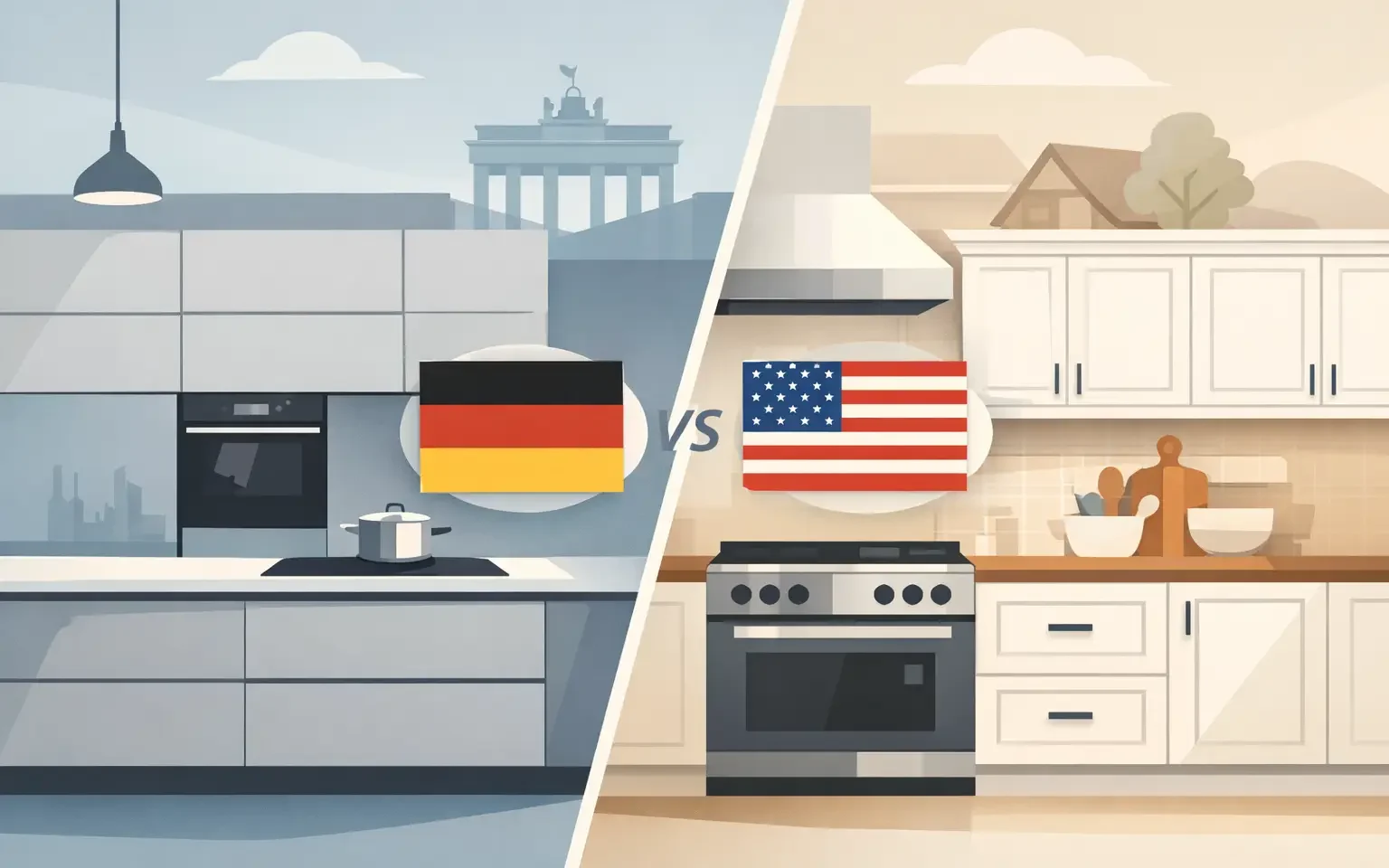
German Cabinets vs American Cabinets Compared
A kitchen can look refined in a showroom and still disappoint in daily use. The real difference often appears months later, when drawers carry heavy cookware, doors must align precisely, and storage needs to support the way your household actually lives. In the discussion of German cabinets vs American cabinets, the most meaningful distinctions involve engineering, manufacturing standards, design language, customization, and the service behind the finished installation.
Neither category is inherently right for every home. American cabinetry includes exceptional custom work, while German-made cabinetry spans a range of price points and specifications. For homeowners planning a high-end kitchen renovation or custom home in Houston, understanding the underlying approach helps make the investment with greater confidence.
German Cabinets vs American Cabinets: The Core Difference
German cabinetry is typically designed as a highly engineered system. Cabinet boxes, drawers, hinges, interior accessories, and door programs are developed to work together under tightly controlled manufacturing standards. The result is a kitchen with a clean visual rhythm, precise reveals, and purposeful storage that can be planned down to the millimeter.
American cabinetry has traditionally been shaped by a more furniture-oriented approach. Many domestic cabinet lines use framed construction, where a face frame sits on the front of the cabinet box and supports the door and drawer fronts. This construction is familiar, durable, and well suited to classic, transitional, and custom-built kitchens. It also supports a broad market ranging from stock cabinetry to highly detailed, locally crafted designs.
The distinction is not simply European versus domestic. It is a difference in priorities. German manufacturers tend to lead with industrial precision, contemporary functionality, and repeatable quality control. American manufacturers often offer broader stylistic range, especially in traditional profiles, decorative details, and made-to-order sizes.
Construction and Engineering
Many premium German kitchens use frameless construction, sometimes called full-access construction. Without a front face frame, the cabinet interior has a wider, more accessible opening. Drawers can extend close to the full width of the cabinet, and interior storage can be organized with fewer obstructions.
German cabinet boxes are commonly built with substantial engineered panels, precision-machined components, and factory-applied edge banding. The strength of the system comes from the way the box, back panel, fittings, and hardware are engineered together. Quality manufacturers use durable hardware tested for extensive opening and closing cycles, which matters in hardworking zones such as cooking, cleanup, and pantry storage.
Traditional American framed cabinets use a face frame that adds visible structure to the front of the box. This can be an advantage when the desired kitchen has inset doors, beaded frames, raised panels, or a more architectural furniture character. However, the frame slightly reduces the clear opening available for drawers and pullouts.
It is worth avoiding broad assumptions here. High-end American frameless cabinetry can offer excellent engineering, and low-grade products can be found in any market. The more useful question is whether the cabinet line provides documented material standards, reliable hardware, consistent manufacturing, and an installation team qualified to execute the design.
Design Language and Visual Impact
German-made cabinetry is especially compelling for homeowners who want a modern, architectural kitchen. Door fronts tend to be flat, refined, and intentionally minimal. Handleless channels, integrated pulls, slim shadow gaps, and continuous grain matching create a composed appearance rather than a collection of individual cabinets.
Finishes are another defining element. German programs often feature super-matte lacquers, textured melamines, natural wood veneers, glass, and contemporary laminates designed for a restrained, high-end palette. The focus is on material quality and surface continuity. A tall pantry wall, island, and appliance run can feel like one tailored interior composition.
American cabinetry offers significant freedom for homeowners pursuing a classic or transitional expression. Shaker doors, painted wood finishes, decorative hoods, glazed profiles, and furniture-style islands remain important strengths of the domestic market. For a home with traditional millwork or historic character, those options may provide a more natural fit.
For many upscale renovations, the choice comes down to the desired architecture of the room. If the kitchen should feel clean-lined, integrated, and quietly luxurious, German cabinetry is often the more direct path. If the goal is ornate detail or a distinctly handcrafted furniture look, an American custom cabinetmaker may be the better fit.
Storage That Works Harder
A premium kitchen should not require homeowners to bend, reach, or search for basic items. German cabinet design places substantial emphasis on ergonomics. Deep drawers replace lower-door cabinets in many layouts, allowing cookware, dishes, and pantry goods to remain visible and accessible from above. Internal dividers, spice pullouts, recycling systems, tray storage, and illuminated cabinetry can be selected as part of the overall plan.
This system-based thinking is particularly valuable in Houston homes where the kitchen often serves as a gathering space. A well-designed island can conceal everyday storage while preserving a calm, uncluttered appearance. Tall cabinets can integrate refrigeration, ovens, pantry storage, and coffee systems into a single wall with minimal visual interruption.
American cabinetry can incorporate similar accessories, particularly at the premium level. Yet the degree of integration varies by manufacturer and cabinetmaker. Some accessories are added after the cabinet box is specified, while German systems are often designed around them from the start. That difference can influence not just convenience but also the proportions and clean finish of the final kitchen.
Customization: Defined Systems vs Open-Ended Craft
German cabinetry is highly customizable, although the customization operates within a precise manufacturing system. Homeowners can choose cabinet widths, heights, depths, finishes, door styles, interior fittings, and appliance configurations from an extensive coordinated program. This approach provides impressive flexibility while protecting alignment, durability, and production quality.
American custom cabinetry may offer more freedom when a room demands an unusual shape, highly specific carved detail, or one-off furniture construction. A skilled local cabinetmaker can build around difficult architectural conditions, reproduce historical profiles, or create dimensions outside a manufacturer’s standard range.
For most modern kitchen renovations, German cabinetry offers more customization than homeowners need, with the added reassurance of standardized precision. For truly unconventional rooms, a hybrid approach may also be appropriate. Custom millwork can solve a singular architectural issue while German kitchen cabinetry delivers the performance and consistency required for the main working areas.
Lead Times, Budget, and Long-Term Value
Price comparisons should account for more than the visible cabinet front. A German-made kitchen may include engineered drawer systems, refined interiors, premium surface technology, and integrated design details that would be upgrades elsewhere. Shipping, project coordination, specialized installation, and appliance integration should also be considered early in the budget.
American cabinetry can be less expensive in certain stock and semi-custom categories, particularly when speed and familiar standard sizes are the priority. At the luxury level, however, fully custom domestic cabinetry can equal or exceed the cost of a premium German kitchen, especially when extensive finishes, specialty hardware, and custom modifications are involved.
Lead time is also project-specific. Imported cabinetry requires thoughtful planning, and a disciplined design process is essential before production begins. Once specifications are approved, the reward is a precisely manufactured kitchen rather than a series of field adjustments. A knowledgeable design and installation partner helps coordinate measurements, site conditions, appliances, countertops, and delivery so the process remains controlled.
Long-term value is measured in more than resale language. It is the confidence that drawers remain smooth, surfaces stay attractive, storage supports daily routines, and the kitchen continues to feel current years after the renovation. A well-planned modern kitchen can provide that value every day.
Choosing the Right Cabinetry for Your Home
Choose German cabinetry when you value modern European design, precision engineering, integrated appliances, highly organized storage, and a consistent high-end finish. It is especially well suited to contemporary homes, luxury remodels, and clients who prefer visual calm over ornamental detail.
Choose American cabinetry when a traditional or highly decorative style is central to the home, when unusual handcrafted details are non-negotiable, or when the project requires truly open-ended custom fabrication. The best choice should reflect the architecture of the home, the way the kitchen will be used, and the standard of finish you expect from the completed space.
At Häcker European Collection, the design conversation begins with those realities: how you cook, what you store, which appliances you prefer, and how the kitchen should feel when it is complete. A thoughtful consultation turns the question from which cabinet is better into which cabinetry system is right for your home, your lifestyle, and the years you plan to enjoy it.

