

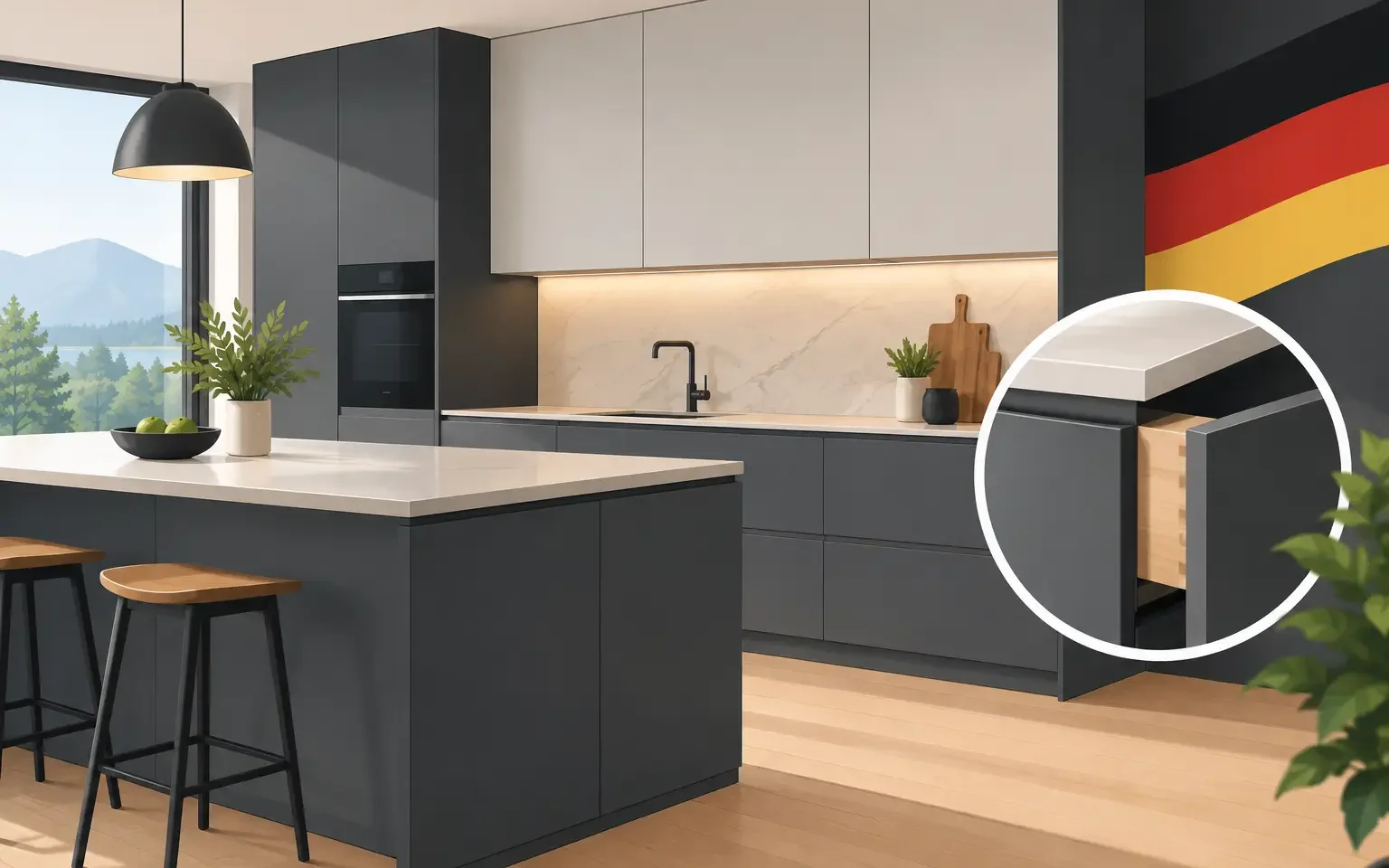
German Cabinetry Reviews: What Quality Looks Like
A beautiful kitchen can be photographed in a few minutes. Living with it is the real test. The most useful German cabinetry reviews look beyond a sleek door style or a dramatic island and ask whether the cabinetry performs well through years of daily cooking, cleaning, storage, and changing household needs.
For homeowners planning a substantial kitchen renovation or custom home in Houston, German-made cabinetry deserves a more considered evaluation. The category is known for modern design, disciplined manufacturing, and highly engineered function. Still, no cabinet line is automatically right for every project. The strongest choice depends on the quality of the product, the skill of the design, the accuracy of the installation, and whether the layout genuinely supports how you live.
What German cabinetry reviews should evaluate
Reviews of premium cabinetry can be misleading when they focus only on first impressions. A comment such as “it looks expensive” says little about cabinet construction, fit, service, or long-term reliability. Conversely, an excellent product can receive a poor review after an underdeveloped design process or an installation that did not account for imperfect walls, floors, or appliance specifications.
A useful review separates the cabinetry from the complete project experience. Look for details about how doors align over time, how drawers operate under weight, whether finishes have held up, and whether the homeowner felt supported when questions arose. In a high-end kitchen, these practical points are part of the luxury experience, not secondary considerations.
German cabinetry is typically designed as a coordinated system rather than a collection of independent boxes. Cabinets, interior fittings, door fronts, trim elements, lighting, and appliance integration are planned to work together. That system-based approach is one reason the finished kitchen can feel so composed. It also means careful planning is essential before an order is placed.
The qualities homeowners notice after installation
Precision in the details
The appeal of German kitchen design often begins with visual restraint. Flat-panel fronts, controlled reveals, integrated handles, and carefully proportioned modules create a calm architectural look. But the design is not merely minimal. It relies on consistent dimensions and precise tolerances, so door gaps, drawer lines, and adjacent panels read as intentional.
This precision matters most in larger compositions: a wall of tall cabinetry, a handleless island, or a kitchen that transitions into a living space. Small inconsistencies can become obvious in a modern room because there is less ornament to distract the eye. Premium German manufacturers build their collections around repeatable engineering standards that support that clean result.
Hardware that earns its place
Drawers and hinges are among the most frequently used components in any kitchen. Quality reviews often mention the quiet, controlled action of soft-close drawers, but the more meaningful question is how the hardware behaves after sustained use. A well-designed drawer system should remain stable when fully loaded with cookware, pantry goods, or dishes. Doors should close smoothly without needing repeated adjustment.
Interior organization also distinguishes a thoughtfully designed kitchen from one that simply has attractive fronts. Deep drawers, divided storage, pull-out systems, and well-planned corner solutions can reduce clutter and make daily routines easier. The best configuration is personal. A serious home cook may prioritize wide cookware drawers and pantry storage, while a household that entertains frequently may value concealed beverage, serving, and cleanup zones.
Materials and finishes suited to real life
German cabinetry is available in a broad range of finishes, from sophisticated matte lacquers and textured wood effects to veneers and durable contemporary laminates. Each has a different character and maintenance profile. A dark matte finish can look exceptionally refined, for example, but homeowners should discuss fingerprints, cleaning practices, and available protective technologies before selecting it.
The right finish should support both the design concept and the way the kitchen will be used. Homes with young children, pets, or frequent gatherings may benefit from especially resilient surfaces and practical color choices. A more formal kitchen with lighter daily use may allow for more delicate material expressions. Premium design is not about choosing the most dramatic finish in a showroom. It is about choosing one that continues to look appropriate in your home.
Why the design process affects the review
A cabinet manufacturer supplies the framework, but the designer determines how effectively that framework serves the room. This is particularly true with European cabinetry, where integrated appliances, paneling, fillers, and millimeter-level planning require early decisions.
Before cabinetry is finalized, a design team should confirm appliance models, ceiling conditions, window and door locations, plumbing, electrical requirements, and flooring transitions. These details influence cabinet widths, clearances, ventilation, and the finished alignment of the room. A late appliance change can affect much more than a single cabinet.
The same principle applies to storage. A kitchen should be planned around actual inventories, not assumptions. Consider where you keep everyday dishes, small appliances, spices, recycling, pet supplies, linens, and oversized serving pieces. When cabinetry is customized around these routines, the kitchen feels efficient without looking overly engineered.
At Häcker European Collection, the process is designed to pair authentic German-made kitchen cabinetry with detailed design guidance and professional installation coordination. That full-service approach helps protect the value of a premium cabinetry investment, especially when a project involves renovation work, specialty appliances, or a tailored combination of kitchen and adjacent storage.
German cabinetry reviews and value: the trade-offs
German cabinetry is positioned in the premium segment, and its price reflects more than a door style. Manufacturing precision, specialized hardware, finish development, quality control, customization options, and the logistics of a European product all shape the investment. For many homeowners, the value is found in longevity, refined function, and a design that remains current rather than trendy.
That said, a higher budget does not eliminate the need to make choices. More complex layouts, exotic finishes, extensive interior accessories, and fully integrated appliance walls can add significant cost. It is often wiser to invest in the cabinetry elements you touch and see every day – drawers, storage zones, key elevations, and durable fronts – than to add features that have little impact on how the room functions.
Lead times also deserve an honest conversation. Imported cabinetry requires disciplined scheduling, particularly when construction timelines are tight. The benefit is access to authentic European manufacturing and a highly considered product. The trade-off is that homeowners and project teams need to make design decisions early and keep specifications stable.
Questions to ask before choosing a cabinet line
Rather than relying on a star rating alone, ask a showroom team to explain how the cabinetry is constructed, what finish options best suit your household, and how service is handled after installation. Request to see full-size samples, drawer interiors, hinge systems, and examples of appliance integration. A door sample can communicate color, but it cannot demonstrate the experience of using a complete cabinet system.
It is also worth asking who measures the space, who verifies final specifications, and who manages installation details. In high-end cabinetry, accountability matters. The final result depends on a coordinated handoff from design to ordering to delivery to installation.
Finally, assess the showroom experience itself. A knowledgeable designer should be able to discuss proportions, material pairings, technical constraints, and budget priorities without pushing every project toward the same look. Your kitchen should reflect your architecture, your routines, and your standards – not a preset package.
A well-reviewed German kitchen is rarely defined by one feature. It is the result of engineered cabinetry, a thoughtful layout, materials selected with purpose, and a team that treats installation as part of the design. When those elements are aligned, the kitchen does more than make a strong first impression. It becomes a composed, dependable space that supports the way you live for years to come.

