
European Cabinet Hardware vs Domestic Options
A kitchen can look beautifully designed on installation day and still feel disappointing every morning if drawers hesitate, doors drift out of alignment, or storage is difficult to reach. That is where the distinction between European cabinet hardware vs domestic options becomes tangible. Hardware determines how cabinetry moves, adjusts, carries weight, and holds its precision over years of daily use.
For homeowners planning a premium kitchen renovation or custom home, this comparison is less about choosing an imported label for its own sake. It is about selecting a cabinet system whose construction, hardware, and design language work together. European hardware is often a defining part of that system.
European Cabinet Hardware vs Domestic: The Real Difference
The simplest comparison can be misleading. Quality domestic cabinetry may use European hinges and drawer slides, while European-made cabinetry can be specified in a range of grades. The more meaningful distinction is the design philosophy behind the cabinet and its hardware.
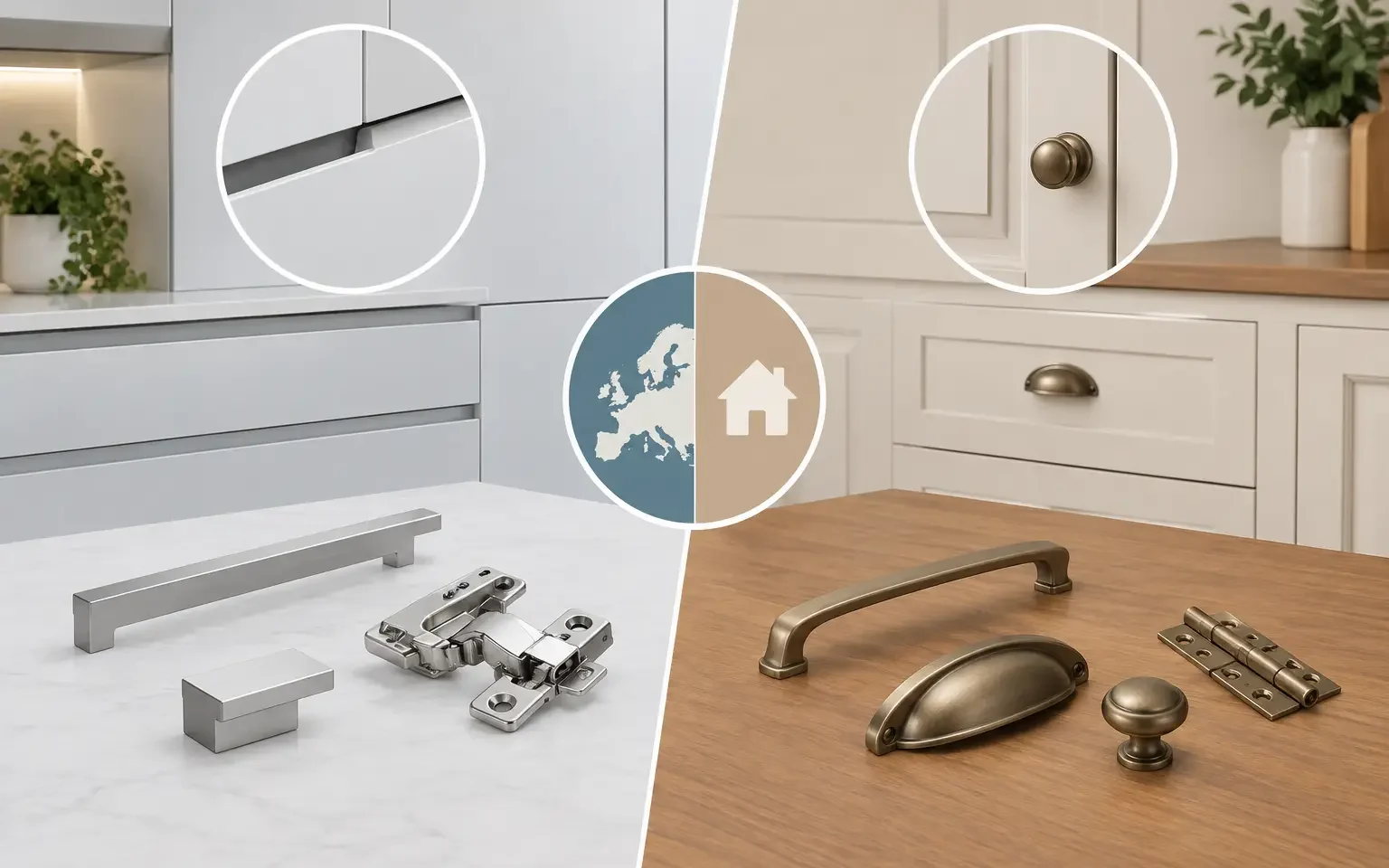
European cabinet systems are generally engineered as integrated, frameless systems. Doors and drawers attach directly to the cabinet box, creating clean reveals, larger interior storage volumes, and a modern architectural appearance. The hardware is designed around precise drilling patterns, concealed components, and fine adjustment after installation.
Traditional domestic cabinetry often follows a face-frame construction method. A solid wood frame sits on the front of the cabinet box, and doors and drawers are fitted within or over that frame. This approach has a lasting place in classic American kitchens, particularly when homeowners want inset doors, decorative profiles, or furniture-inspired detailing. It can, however, reduce usable opening width and require a different approach to hinges, drawer slides, and tolerances.
Neither construction style is automatically right for every home. The decision should begin with the desired aesthetic, storage requirements, and expectations for daily performance.
Why European Hardware Feels Different in Daily Use
The difference is most apparent when you open a drawer, adjust a cabinet door, or load a pull-out with cookware. Premium European systems are engineered for controlled motion rather than simply opening and closing.
Concealed hinges and precise adjustment
European-style hinges are usually concealed when the door is closed. The result is a clean cabinet interior and uninterrupted exterior lines, which suit contemporary kitchens, handleless fronts, and refined minimalist detailing.
More importantly, these hinges typically allow adjustment in several directions. A qualified installer can fine-tune side-to-side position, depth, and height so reveals remain consistent across a wall of cabinetry. In a large kitchen with tall pantry doors, integrated appliances, and wide drawer banks, that degree of adjustment protects the visual discipline of the design.
Face-frame domestic cabinets can also use concealed hinges, including excellent soft-close options. Yet the frame itself changes the geometry of the opening. With a European frameless cabinet, the hardware is part of a system designed to maximize access and keep exterior lines intentionally narrow.
Full-extension drawers and usable storage
High-end European drawer systems are known for full extension, soft closing, and carefully engineered load ratings. Full-extension slides bring the back of the drawer into view, making deep storage more useful for cookware, dishes, pantry supplies, and organizers.
The box construction also matters. Many European drawers use slim metal sides with engineered bases and backs, allowing a generous internal volume without bulky wood sidewalls. The visual effect is clean and contemporary; the practical benefit is storage that works harder in the same footprint.
Domestic drawer boxes are often made from hardwood or plywood, and that can be an excellent choice for a traditional kitchen. Dovetail joinery has genuine visual appeal and speaks to a particular craft tradition. But it is not the only measure of quality. A precision-made metal drawer system can offer exceptional alignment, easy-clean interiors, integrated dividers, and dependable motion under frequent use.
Soft close is only the beginning
Soft-close hardware is now common at many price points, so it should not be treated as a luxury feature by itself. The better question is how reliably the system performs when doors and drawers are used hundreds of times a week.
Premium hardware controls closing speed, manages heavier loads, and maintains alignment without requiring homeowners to baby the cabinetry. It also supports specialized functions such as interior pull-outs, corner mechanisms, lift-up wall cabinet doors, pocket doors, waste systems, and illuminated storage. These components are especially valuable in kitchens where every cabinet must be purposeful.
The Design Advantage of an Integrated European System
European cabinetry is often selected because it makes a kitchen feel intentional rather than assembled from separate decorative elements. Hardware plays a central role in that result.
Frameless construction allows for larger doors and drawers, close and even reveals, and a broad range of handleless or integrated-handle solutions. It supports tall cabinetry that reads as a composed architectural plane, particularly when finished in matte lacquer, textured wood, glass, or premium laminate.
This is also why modern German-made kitchens frequently feel more tailored. Cabinet dimensions, interior fittings, fronts, and mechanisms are developed as a coordinated platform. Rather than treating storage accessories as add-ons, the system can be specified around the homeowner’s routines from the outset.
For example, a cooking zone may include wide drawers for pots, internal drawers for utensils, a shallow spice pull-out, and a concealed recycling center. A breakfast area may use pocket doors to conceal coffee equipment when not in use. A full-height pantry can be organized around adjustable interior pull-outs rather than deep shelves that hide items at the back.
These capabilities are available in some domestic lines, particularly custom and luxury offerings. The difference is often consistency. European manufacturers tend to build this level of function into the core cabinet program rather than treating it as an exception.
Where Domestic Cabinet Hardware Can Be the Better Fit
Domestic cabinetry should not be dismissed as a lesser category. American cabinetmakers excel at certain styles and applications, including historic homes, formal traditional interiors, and highly decorative millwork. A face-frame cabinet with inset doors, custom molding, and furniture-style proportions may be exactly right for a home with that architectural language.
Local custom fabrication can also be valuable when a project requires unusual dimensions, a specific wood species, or a close match to existing millwork. Lead times, service access, and repair preferences can favor a domestic source in some situations.
The trade-off is that a highly customized domestic cabinet may not offer the same level of factory-developed interior engineering, hardware integration, or dimensional consistency as a premium European system. That does not make it inferior. It means homeowners should evaluate performance details rather than relying on broad labels such as custom, imported, or luxury.
What to Ask Before Choosing Cabinet Hardware
A showroom appointment should go beyond comparing door colors. Open the drawers fully. Test the movement of a tall door. Ask how the hardware is adjusted after installation and what load capacity the drawer system is designed to support.
It is also worth asking whether the hardware is standard across the kitchen or selectively upgraded. Confirm which pull-outs, organizers, and specialty mechanisms are included in the quoted design. A well-planned kitchen can appear less expensive on paper when key functional pieces have been omitted.
For a premium renovation, consider the cabinet box and hardware together. The best hinge cannot compensate for an unstable cabinet, and a beautiful door front cannot make poor storage planning feel luxurious. Materials, construction, installation accuracy, and hardware all contribute to the final experience.
At Häcker European Collection, this integrated approach is central to the design process. German-made kitchen cabinetry and Italian-made storage systems are specified around the architecture of the home and the way each client lives, rather than chosen as isolated products.
A Better Way to Compare Value
Initial price matters, but it rarely tells the full story. A cabinet package with fewer internal accessories, standard slides, or limited adjustability may cost less upfront while delivering less usable storage and a less refined experience over time.
Evaluate value through the details you will touch every day: drawer access, door alignment, pantry visibility, organization, cleaning, and the ability of the cabinetry to remain composed after years of use. In a kitchen renovation, hardware is not a finishing detail. It is the mechanism that turns cabinetry from a visual surface into a high-performing part of the home.
Bring your floor plans, inspiration images, and storage concerns to a design consultation. The right cabinet system should not merely suit the room. It should make the routines within it feel considered, efficient, and enduring.