

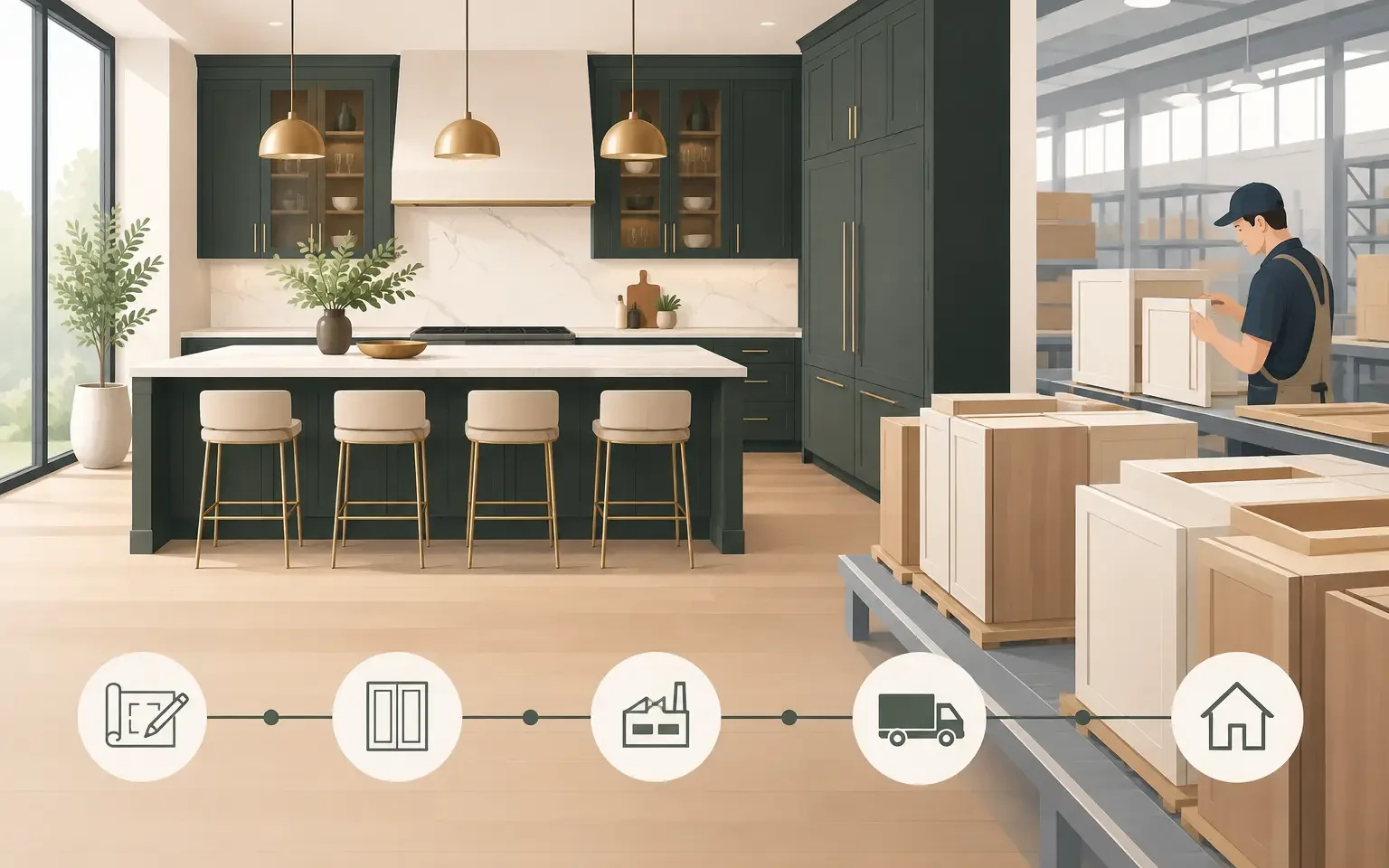
Cabinet Lead Times for Your Luxury Kitchen
A kitchen renovation rarely falls behind because a homeowner chose the wrong door style. It falls behind when cabinetry, appliances, construction work, and installation are planned as separate decisions. Cabinet lead times deserve attention early because cabinetry sets the pace for nearly every finish and trade that follows – from flooring and electrical placement to countertop templating and final appliance installation.
For a high-end European kitchen, waiting is not simply a matter of production. It reflects the care required to design, manufacture, ship, receive, inspect, and install a kitchen built specifically for your home. A clear timeline protects the investment while giving your designer room to refine the details that make a modern kitchen feel considered rather than merely completed.
What Cabinet Lead Times Actually Include
Cabinet lead time is often described as the period between placing an order and receiving cabinets. In practice, that definition is too narrow. For German-made cabinetry, the full timeline begins with approved design documents and final material selections, then moves through manufacturing, overseas freight, domestic handling, delivery coordination, and installation readiness.
The production period begins only after every relevant decision has been confirmed. That includes the cabinet configuration, door style, finish, interior accessories, handle selection, appliance specifications, lighting provisions, and any custom panels required to create an integrated appearance. Changes after release can affect both timing and cost, particularly when they involve custom dimensions or specialty finishes.
For most premium European kitchen projects, homeowners should plan well ahead of their desired installation date. The precise schedule depends on the scope of the kitchen, factory capacity, shipping conditions, and the level of customization. A straightforward project with standard finishes may move differently than a large custom home with lacquered fronts, specialty veneers, integrated pocket doors, and a fully coordinated utility or pantry area.
Why German-Made Cabinet Lead Times Are Different
Premium cabinetry is not held in large domestic warehouses waiting to be assigned to a project. Häcker kitchens are manufactured to order in Germany, allowing the finished cabinetry to align with the exact room dimensions, design intent, and functional requirements of the home.
That made-to-order process is a meaningful advantage. It allows for a more tailored kitchen with refined proportions, coordinated finishes, and integrated storage rather than a collection of standard boxes adapted at the job site. It also means the project requires disciplined planning. The factory cannot begin producing components that have not yet been specified and approved.
International logistics add another layer. Ocean freight schedules, port conditions, customs processing, and local transportation all affect the journey from factory to home. These variables are manageable with experienced coordination, but they should never be treated as an afterthought. A realistic schedule includes reasonable allowance for transit and receiving, rather than assuming cabinetry will arrive on the first possible date.
This is one reason a consultation-led process is so valuable. An experienced kitchen designer can identify the decisions that must be made before ordering, coordinate with the renovation team, and establish a project sequence that accounts for cabinetry from the start.
The Decisions That Can Extend Your Timeline
Not every choice has the same effect on cabinet lead times. A carefully selected standard color may be readily available within the normal manufacturing cycle, while a special finish or highly customized detail can require additional coordination. Neither is inherently better. The appropriate choice depends on the design vision, the project schedule, and the homeowner’s priorities.
Custom sizing is one common factor. European cabinetry is known for its precise planning flexibility, which makes it well suited to contemporary kitchens with architectural constraints, unusual ceiling heights, or a desire for uninterrupted visual lines. However, every nonstandard element should be resolved before the order is finalized.
Appliances can also influence the schedule more than homeowners expect. Refrigeration, ventilation, ovens, dishwashers, and coffee systems each require accurate specifications for cabinet openings, clearances, electrical locations, and ventilation needs. If an appliance model changes after cabinetry is ordered, the surrounding cabinetry or panels may need to be revised. Selecting appliances early helps preserve both design integrity and installation timing.
Countertops are another critical dependency. Stone fabrication typically follows cabinet installation and final field measurements. This sequence is necessary for an accurate fit, especially in kitchens with large islands, waterfall edges, or complex wall conditions. Countertop lead time should be built into the overall renovation schedule rather than viewed as a final, quick step.
How to Plan a Kitchen Renovation Around Cabinet Delivery
The best time to begin a cabinet conversation is before demolition, not after the room has been opened up. Starting early gives the design team time to understand the space, develop the layout, coordinate appliances, and produce an accurate proposal before construction decisions become expensive to reverse.
For a significant renovation, the cabinetry order should be placed only when the design is truly resolved. That does not mean rushing through the selection process. It means giving decisions the appropriate amount of attention early enough that the factory timeline can begin without compromising the design.
Your contractor should receive finalized cabinet plans before rough-in work proceeds. Cabinet drawings inform electrical outlets, plumbing, gas lines, lighting, ventilation, framing, and appliance locations. A kitchen can look beautiful on paper yet become difficult to install if the trades are working from assumptions rather than coordinated documentation.
Before cabinetry arrives, the room should be ready for installation. Floors, walls, and ceiling conditions must be assessed according to the project plan, and the site should be secure, dry, and accessible. Premium cabinetry should not be delivered into an active construction environment where it could be exposed to moisture, dust, or damage. Proper receiving and staging protect the condition of the materials before installation begins.
A Realistic Sequence for Cabinet Installation
A well-managed project follows a logical order. Design development comes first, followed by material and appliance selection, final measurements, and order release. Manufacturing and shipping occur while the construction team completes demolition, structural work, rough-ins, drywall, and other site preparation.
Once cabinets are received and the room is ready, installation can begin. After the cabinetry is installed and leveled, countertops are templated. Fabrication then follows, with countertop installation occurring before certain final appliance connections, plumbing fixtures, and backsplash work. Finishing details such as hardware adjustments, lighting, touch-ups, and final alignment complete the process.
There are exceptions. In some projects, flooring is installed before cabinetry; in others, it is installed afterward. The correct approach depends on the flooring material, cabinet design, island placement, and future flexibility. Similarly, a renovation involving significant structural changes may require more time before final measurements can be confirmed. A strong project team accounts for these conditions rather than forcing every kitchen into the same schedule.
How to Protect Your Project From Delays
The most effective way to reduce schedule pressure is to make key decisions early and avoid ordering cabinetry based on unfinished assumptions. Confirm appliance models before cabinet release. Review drawings carefully. Consider whether specialty finishes, custom interior fittings, or integrated storage elements are essential to the design, and allow appropriate time for them.
Homeowners should also be cautious about promises that sound unusually fast. Short lead times can be useful for limited projects, but they may indicate stock cabinetry, fewer finish options, or less room for customization. For a luxury renovation, the goal is not simply to receive cabinets quickly. It is to receive the right cabinets, in the right condition, ready for a precise installation.
At Häcker European Collection, the design process is built around this level of coordination. A detailed consultation helps align cabinetry, appliance planning, construction requirements, and installation expectations before the project moves into production.
A well-planned kitchen gives time the role it should have: not a source of uncertainty, but a tool for achieving better proportions, better function, and a more enduring result. Schedule a consultation early enough to choose your cabinetry with confidence, not compromise.

