
Appliance Garage Ideas for a Refined Kitchen
The most useful appliances are often the least beautiful: the espresso machine, toaster, blender, and stand mixer that earn a permanent place on the counter. Thoughtful appliance garage ideas solve that tension. They preserve immediate access to the tools you use every day while restoring the calm, architectural appearance expected from a high-end kitchen.
An appliance garage is not simply a cabinet with a door. In a well-designed modern kitchen, it is an integrated work zone with the correct clearances, power, ventilation considerations, and door system. When planned alongside German-made cabinetry rather than added as an afterthought, it can make the entire kitchen feel more considered and substantially easier to use.
What Makes an Appliance Garage Work
The best appliance garages begin with honest habits. A household that makes coffee several times a day has different requirements than one that uses a blender only on weekends. The goal is not to conceal every small appliance. It is to create a dedicated home for the ones that would otherwise interrupt the countertop and remain out all week.
Location matters as much as the cabinet style. An appliance garage should sit near the activity it supports, with sufficient landing space nearby. A coffee station belongs near mugs, water, and refrigeration. A baking station is most practical near pantry storage and preparation space. A toaster or blender zone should be close to the sink or dishwasher if cleanup is frequent.
For a refined result, the appliance garage should read as part of the cabinetry composition when closed. Matching fronts, aligned reveals, and consistent finishes matter. A garage that is visually disconnected from the surrounding cabinetry can look like a compromise, while one integrated into the design becomes an intentional detail.
Appliance Garage Ideas That Suit Modern Kitchens
Create a dedicated coffee cabinet
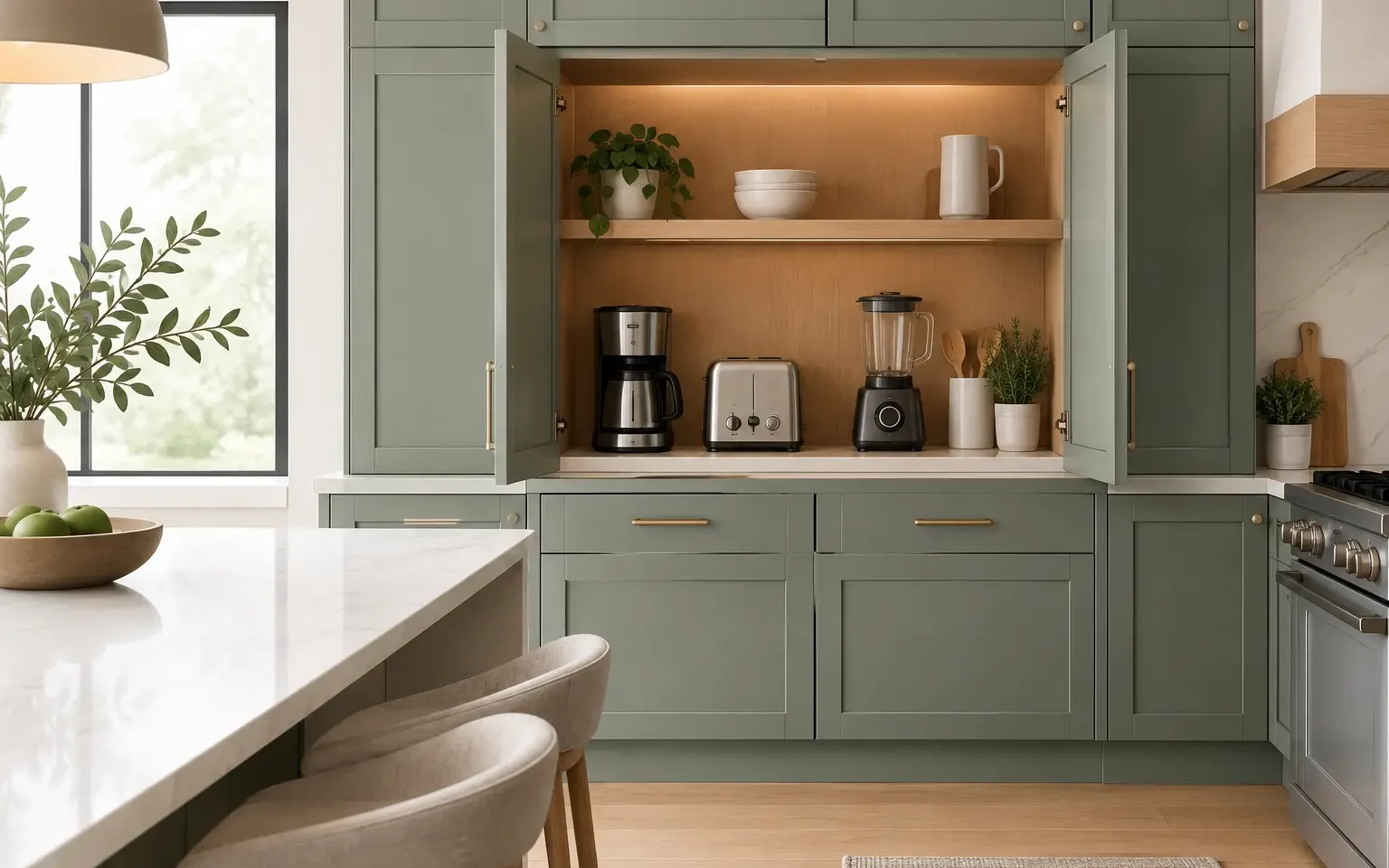
A coffee garage is among the most successful options for a primary residence. It can hold an espresso machine, grinder, kettle, mugs, beans, and daily supplements behind a single door. When the door is open, the entire morning routine is contained in one purposeful area. When closed, the kitchen returns to a clean, uncluttered elevation.
Plan for the depth of the espresso machine, including handles, water reservoirs, and room to lift or refill components. A pull-out shelf may be worthwhile for heavier equipment, but only if it does not create an awkward workflow. Many owners prefer a fixed counter-height surface inside the cabinet because it allows the machine to remain plugged in and ready for use.
Use a pocket-door appliance station
Pocket doors slide back into the cabinet sides, leaving the opening fully clear. This is an elegant choice for wide appliance garages, particularly where a hinged door would project into a busy aisle. It also allows the interior to function like a small secondary worktop during entertaining.
The trade-off is that pocket-door systems require careful engineering and sufficient cabinet width. They are an investment, but they offer a more furniture-like appearance than a conventional upper cabinet. For homeowners pursuing a minimal European kitchen, the uninterrupted access is often worth the added planning.
Choose a lift-up door for a compact counter run
Lift-up doors work especially well above a shorter countertop section. The door rises out of the way, giving access to a toaster, mixer, or blender without taking up lateral space. In a compact kitchen, this can be more efficient than side-hinged doors.
Door hardware quality is essential. A premium lift system should open smoothly, stay securely in position, and close without slamming. It should also be specified around the actual front size and finish, since heavier materials may require different hardware settings.
Build an appliance garage into a tall cabinet wall
Not every appliance garage needs to sit directly on the main counter. A tall cabinet wall can incorporate a concealed appliance niche at a comfortable working height, with drawers or pull-outs below and pantry storage above. This approach works well in larger kitchens where the primary island is intended to remain completely clear.
A tall-cabinet garage is particularly effective for coffee service, juicing, or a concealed microwave. It creates a self-contained zone away from the main cooking area, which is useful when multiple people use the kitchen at the same time. It also gives the cabinetry wall more depth and purpose than a row of standard storage units.
Add retractable shelves for heavy equipment
Stand mixers, food processors, and high-performance blenders can be cumbersome to lift from a deep shelf. A heavy-duty pull-out shelf brings the appliance forward for use, reducing strain and making the garage more practical. This detail is especially valuable when the appliance is used often but does not belong permanently on display.
Do not assume every appliance needs a pull-out. A fixed shelf is usually more stable, simpler, and easier to clean. Retractable mechanisms make sense when the weight, depth, or height of an appliance creates a genuine usability issue.
Conceal a baking and prep zone
For serious home cooks, an appliance garage can become a compact prep station rather than a storage box. Include a mixer, scale, bowls, baking tools, and a pull-out drawer for ingredients. Interior lighting can make this zone feel intentional while improving visibility early in the morning or during evening cooking.
This option benefits from a durable work surface inside the cabinet. Consider how flour, heat, steam, and splashes will affect the finish over time. Premium cabinetry materials are designed for daily life, but the interior specification should match the intensity of use.
Details That Should Be Designed Early
An appliance garage is only as functional as its electrical plan. Outlets must be located where plugs will not interfere with the appliance or cabinet back. They should be accessible without forcing cords across a work surface. Depending on the equipment and local code requirements, a designer and qualified electrician can determine the appropriate outlet type and placement.
Ventilation deserves equal attention. Most countertop appliances do not require a dedicated ventilation system, but they still produce heat, moisture, or steam. Toasters and espresso machines are common examples. Leave practical clearance around the appliance, follow manufacturer requirements, and avoid trapping heat in a tightly sealed enclosure. An appliance garage is not the right location for every device.
Interior lighting is another small decision with a substantial effect. Integrated LED lighting improves task visibility and brings a high-end finish to the cabinet interior. It is especially useful in darker finishes, tall cabinetry niches, and coffee stations used before sunrise. Lighting can be activated with the door, a sensor, or a discreet switch depending on the design.
Finally, consider cleaning. Crumbs, coffee grounds, and splashes collect quickly in high-use areas. A simple interior with a durable base surface is often more valuable than elaborate dividers that make wiping down difficult. The most luxurious kitchen is one that remains effortless to maintain.
Selecting the Right Door Style
The door style should reflect both the kitchen architecture and the way the appliance garage will be used. Pocket doors offer a polished, open work zone. Lift-up doors are efficient over counters. Side-hinged doors suit narrower cabinets and can be a cost-conscious choice when there is sufficient clearance. Tambour doors provide a distinctive look but should be chosen carefully, as their tracks can reduce usable interior space and collect debris over time.
For a truly integrated look, use the same front material as the surrounding cabinetry. Matte lacquer, textured laminate, wood veneer, and glass each create a different mood, but continuity is what makes the garage feel custom. The interior can either match for a quiet monolithic effect or introduce a complementary finish to define the niche.
When an Appliance Garage Is Not the Best Choice
An appliance garage is not automatically the answer to countertop clutter. In a very small kitchen, dedicating valuable counter and cabinet volume to hidden appliances may limit more essential storage. If an appliance is used only occasionally, a pantry cabinet or lower pull-out may be a better allocation of space.
Likewise, homeowners who prefer a fully open kitchen with a visible coffee setup may find that a garage adds an unnecessary step. The most successful designs support personal routines rather than forcing a particular aesthetic. A designer should ask what stays out, what gets used, and how the kitchen functions during a typical week before specifying cabinetry.
At Häcker European Collection, appliance garages are planned as part of a complete kitchen environment, not as a decorative add-on. The right configuration can turn a daily source of visual clutter into a discreet, highly functional feature that feels native to the architecture of the room.
A well-proportioned appliance garage leaves the countertop clear without making the kitchen less lived-in. It gives everyday tools a proper place, preserves the beauty of premium cabinetry, and makes the first coffee of the day feel just a little more composed.